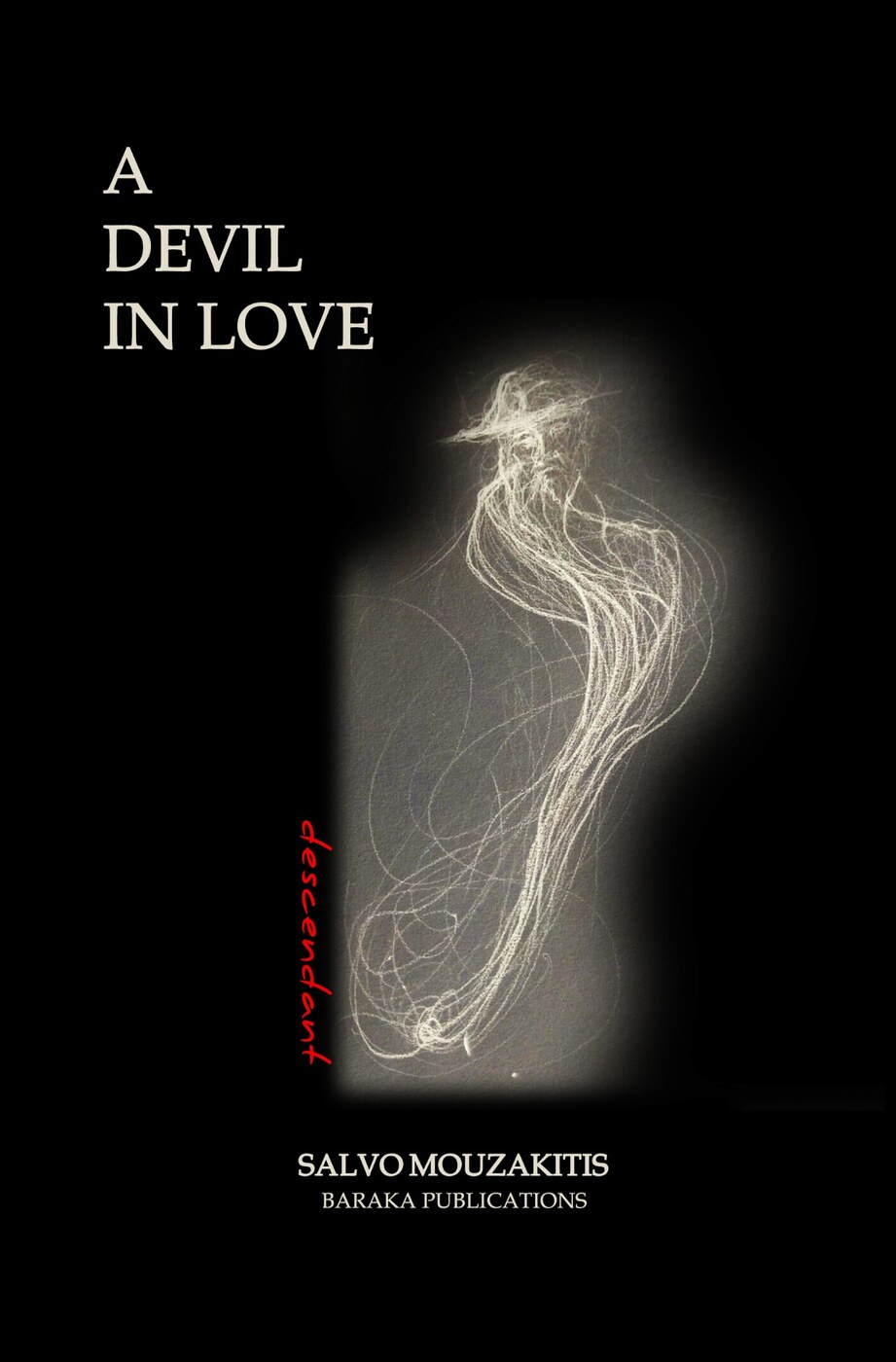
...However, exactly because a subtle message is never loud but it is more like a whisper, it is necessary for the message to be transmitted in silence. This is the reason that I implore you to begin reading this book as if you are entering a dark and quiet room; away from the crowd’s maddening noise, free from every day’s trivial concerns and fully intend to listen to the subtleness of the spirit that this book conveys...
...Now, in analogy to biological Death, the dissolution, and the end of all the illusions we carry is experienced as Death, in psychological terms. It is for this reason that we strenuously resist it and, of course, we do this subconsciously. And because we resist unconsciously, it is impossible to identify this resistance by ourselves — in our capacity of a person who is “looking to discover their own self”.
...It takes a devil in love to inspire and awaken the fire within us, not the fires of hell, but the fire of Eros. Because no one can face death without Eros. My wish for you is that you also find this devil in love, if you really want to, in order to receive the necessary impetus and his guidance — thereby changing the otherwise already prescribed course of your life. Be warned however! Do not rush to choose a devil — you cannot! No seeker can find the devil himself...
Οπισθόφυλλο
The Author
Salvo Mouzakitis works as an attorney in Corfu, Greece. He was born in Athens but due to his parent's occupation he relocated many times in his early youth. He finished his secondary education in Patras, Greece and then attended Law School back in Athens. He grew up within the confines of the generally accepted social norms and within a family that adhered to, and genuinely represented modern Greek cultural values - with both his parents having a rich background in classics. As a result, he was always preoccupied with the evident fact that the perception of “right versus wrong” depends on the local conditions of the society and the era one examines.
This realization forced him, at an early age, to question the authority and veracity of prevailing ethics and earned him the designation of “revolutionary”. However, it also, initiated him into the mythology, symbols, texts, and ways of other cultures and traditions – whether, historically recent, or ancient. It also revealed to him the relative nature of what was right and what wrong. Still, despite his newly acquired perspective, his behavior was determined by the social stereotypes and his formal education, in ways he did not, then, realize.
Given time and by socializing with extraordinary people whom he was lucky to meet, he reached the empirical conclusion that the notion of right or wrong is a subjective experience, and that nothing is necessarily what it appears to be. That everything is determined by the Way of Acting, i.e., by the Internal makeup of the individual and not by the action itself.